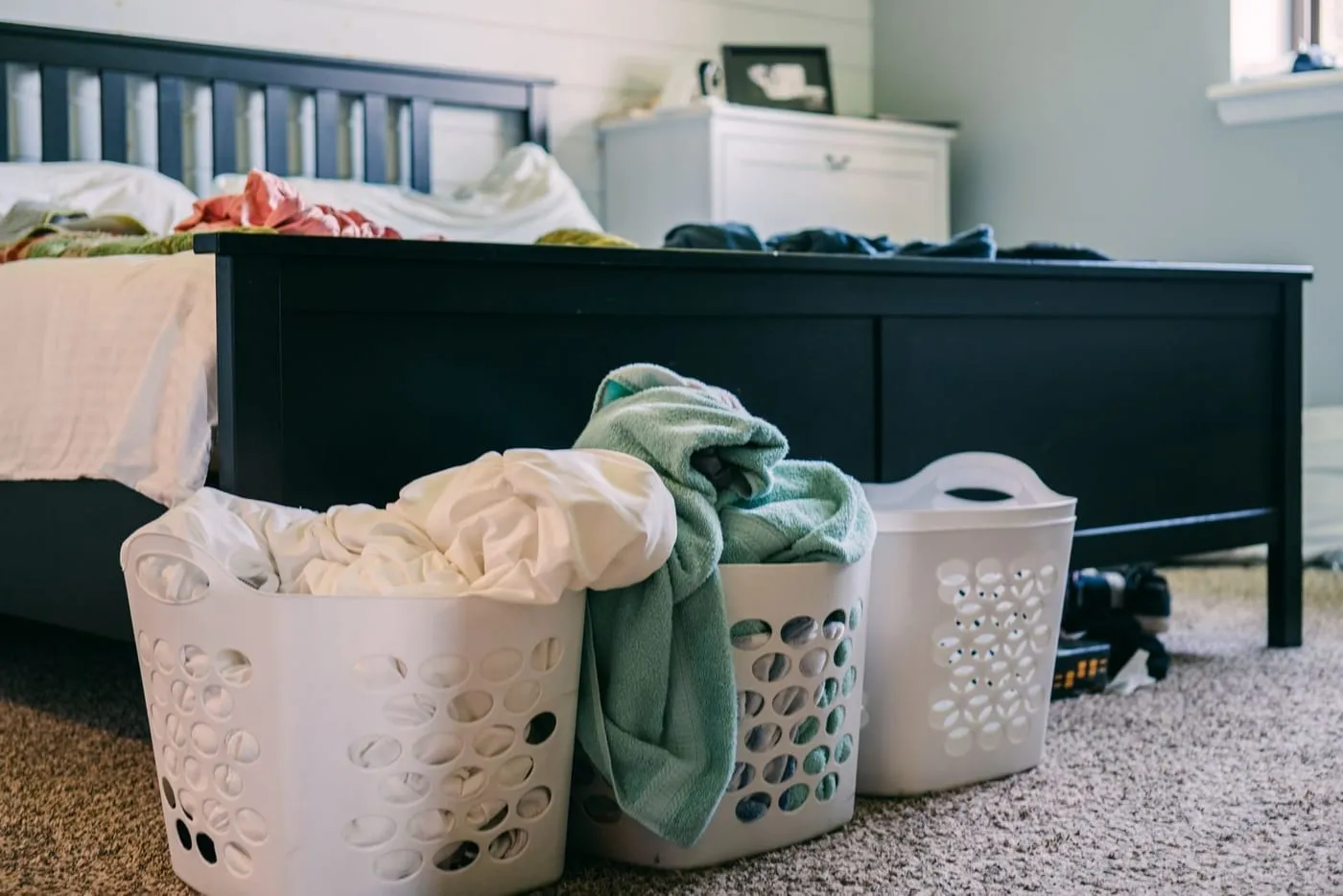
The space under your bed can hold two full storage bins per side, yet most Canadian renters use it for a stray sock and a suitcase. I measured my own bed frame before writing this: 11 cm of clearance, just short of the 15 cm most bins need. A $22 CAD set of risers fixed that in ten minutes.
This post is a deep dive on that one zone specifically. For the full-room approach, see our bedroom storage ideas guide, and for storage across the whole apartment, check our small apartment storage ideas roundup.
Key Takeaways
- Bed risers (~$25 CAD) add roughly 15 cm of clearance and are usually the single best first purchase for this zone.
- Flat lidded bins suit shoes and folded items; vacuum bags suit bulky seasonal gear like duvets and coats.
- Rolling drawers are worth it only if your bed clears at least 15–18 cm.
- Never store books, leather, or unsealed fabric under a bed due to moisture and mold risk.
- Measure clearance with a tape measure before buying anything.
Quick Comparison: Under-Bed Storage Options
| Option | Cost (CAD) | Clearance Needed | Best For |
|---|---|---|---|
| Bed risers | $20–$28 | Adds ~12–15 cm | The first fix if clearance is under 15 cm |
| Flat lidded bins | Varies (bin cost) | ~15 cm | Shape-sensitive items: shoes, folded sweaters |
| IKEA SKUBB bags | ~$14 (2-pack) | ~12 cm | Off-season clothes and linens, softer-sided |
| Vacuum-seal bags | $25–$30 (6-pack) | Works in tight clearance | Bulky items: duvets, winter coats |
| Rolling drawers | $40–$70 | 15–18 cm minimum | Frequent access, platform beds with enough gap |
Why Bed Risers Are the First Thing to Buy
Bed risers are the cheapest, highest-leverage purchase for this zone, and most Canadian retailers sell a set for $20–$28 CAD (Canadian Tire, 2026). Adding 12–15 cm of clearance often turns a bed frame from unusable storage into space for two full rows of bins.
My bed frame sat at 11 cm before risers, just under the 15 cm most flat bins need. A $22 CAD set of stackable plastic risers from Amazon.ca solved it in about ten minutes, no tools required. I went from fitting nothing to fitting four IKEA SKUBB bags side by side.
Risers come in a few styles worth knowing about.
Stackable Plastic Risers
These sit under each leg or corner of the frame and stack to add height in roughly 5 cm increments. They’re the cheapest option, generally $18–$28 CAD for a set of four (Amazon.ca, 2026), and work with almost any bed frame that has legs.
Bed Frame Extenders for Platform Beds
Platform beds without legs need a different approach: a frame extender or a set of furniture blocks made specifically for platform bases. These run closer to $25–$40 CAD and distribute weight more evenly across a flat base than stackable risers alone.
Should You Use Flat Bins or Vacuum-Seal Bags?
The right choice depends on what you’re storing, not personal preference. Flat lidded bins protect shape-sensitive items like shoes and folded sweaters, while vacuum-seal bags compress bulky items like duvets and winter coats to about a quarter of their original size (IKEA Canada, 2026).
Bins keep their shape and are easy to slide in and out one-handed. That matters if you’re grabbing something specific, like a single pair of boots, rather than an entire seasonal wardrobe swap. IKEA’s SKUBB under-bed bags run about $14 CAD for two and zip closed to keep dust out.
Vacuum bags win on raw volume. A queen duvet that takes up an entire bin can compress down to a slim rectangle with a vacuum bag, which matters most if your clearance is tight. A six-bag mixed set runs $25–$30 CAD at Amazon.ca. The tradeoff: vacuum bags aren’t great for anything with structure, like shoes, since they crush under pressure.
My approach: I use bins for anything I might need on short notice (extra bedding, off-season shoes) and vacuum bags only for things I won’t touch for months, like winter coats in July. Mixing both gets more total capacity than committing to one system.
What About Beds With Almost No Clearance?
Low-profile and platform beds with under 10 cm of clearance can still get storage value from slim rolling drawers built specifically for tight gaps. These purpose-built units, sold at IKEA Canada and Amazon.ca from about $40–$70 CAD, slide flush and roll out on casters.
Rolling under-bed drawers work best once you’ve got at least 15–18 cm of clearance; below that, even the slimmest models won’t fit. If risers aren’t an option (some platform beds can’t take them structurally), a rolling drawer designed for 10–12 cm gaps is your next best bet, though selection narrows fast at that height.
Measure twice before ordering. Rolling drawers are bulkier to return than a flat bin, and a lot of Canadian apartment listings round bed clearance up when they shouldn’t.
What Should You Never Store Under a Bed?
Skip books, leather goods, solid wood items, and anything unsealed made of fabric. Under-bed space gets minimal airflow and traps moisture close to the floor, which raises mold and mildew risk even in apartments that feel dry (Canada Mortgage and Housing Corporation, 2024).
Books absorb humidity from the floor and can develop mildew spots you won’t notice until the smell shows up. Leather cracks or grows mold in low-airflow, low-light conditions. Solid wood furniture pieces and instrument cases fare the same way over a Canadian winter, when indoor humidity swings are common.
The fix isn’t complicated: store only what’s fully sealed. A vacuum bag or a bin with a tight lid blocks the moisture exposure that causes the problem in the first place. Loose fabric bins with open weaves don’t offer the same protection.
What’s safe: sealed bins of off-season clothes, zipped bags of extra bedding, shoes in a closed container, board games in their original boxes.
What’s not: books, leather bags or shoes without a dust cover, untreated wood boxes, anything already slightly damp when it goes under.
How Do You Measure Your Actual Clearance?
Measure before you buy anything, not after a bin shows up that doesn’t fit. Use a tape measure at the lowest point of the frame, not the highest corner, since bed frames often slope and the tightest spot is what actually matters (Consumer Reports, 2023).
I measured my own frame in three spots, headboard end, footboard end, and the middle, and got three slightly different numbers. The lowest one, 11 cm, was the real constraint. If I’d measured only the highest point, I’d have ordered bins that didn’t fit at all.
Write the number down before you shop. Most flat bins need about 15 cm, IKEA SKUBB bags need closer to 12 cm since they’re softer-sided, and rolling drawers need 15–18 cm minimum. Bed risers close most of that gap for under $25 CAD if you come up short.
Is it worth the ten minutes? Every time. A returned bin that doesn’t clear the frame costs more in hassle than the measurement ever would.
Frequently Asked Questions
Do bed risers actually work in a small apartment? Yes, a $20–$28 CAD set from Amazon.ca or Canadian Tire adds roughly 12–15 cm of clearance under most frames. That’s often the difference between fitting nothing and fitting two full rows of bins.
Should I use vacuum bags or bins for under-bed storage? Vacuum bags compress bulky items like duvets and coats to a quarter of their size, best under 15 cm of clearance. Flat lidded bins protect shape-sensitive items like shoes and are easier to slide in and out.
What should you never store under a bed? Skip books, leather, unsealed fabric, and solid wood. Under-bed space traps moisture with little airflow, which raises mold and mildew risk even in a dry apartment.
How much clearance do I need for under-bed storage bins? Standard flat bins need about 15 cm. Measure your bed’s actual gap first; many platform frames only clear 8–10 cm before risers.
Under-bed storage is one of the few upgrades in a small apartment that costs almost nothing and adds real capacity. Start by measuring your clearance, then buy risers if you’re short, and pick bins or vacuum bags based on what you’re actually storing. It’s a twenty-minute project that can free up an entire closet’s worth of space. For the rest of the bedroom, our bedroom storage ideas guide covers closets, hangers, and furniture in full, and our complete small apartment storage roundup covers every room in the unit. For more ways to stretch a tight setup budget, see our budget organization ideas, and for the bathroom see small apartment bathroom storage ideas. If risers alone aren’t enough clearance, our storage bed buying guide covers frames built with the storage already underneath.