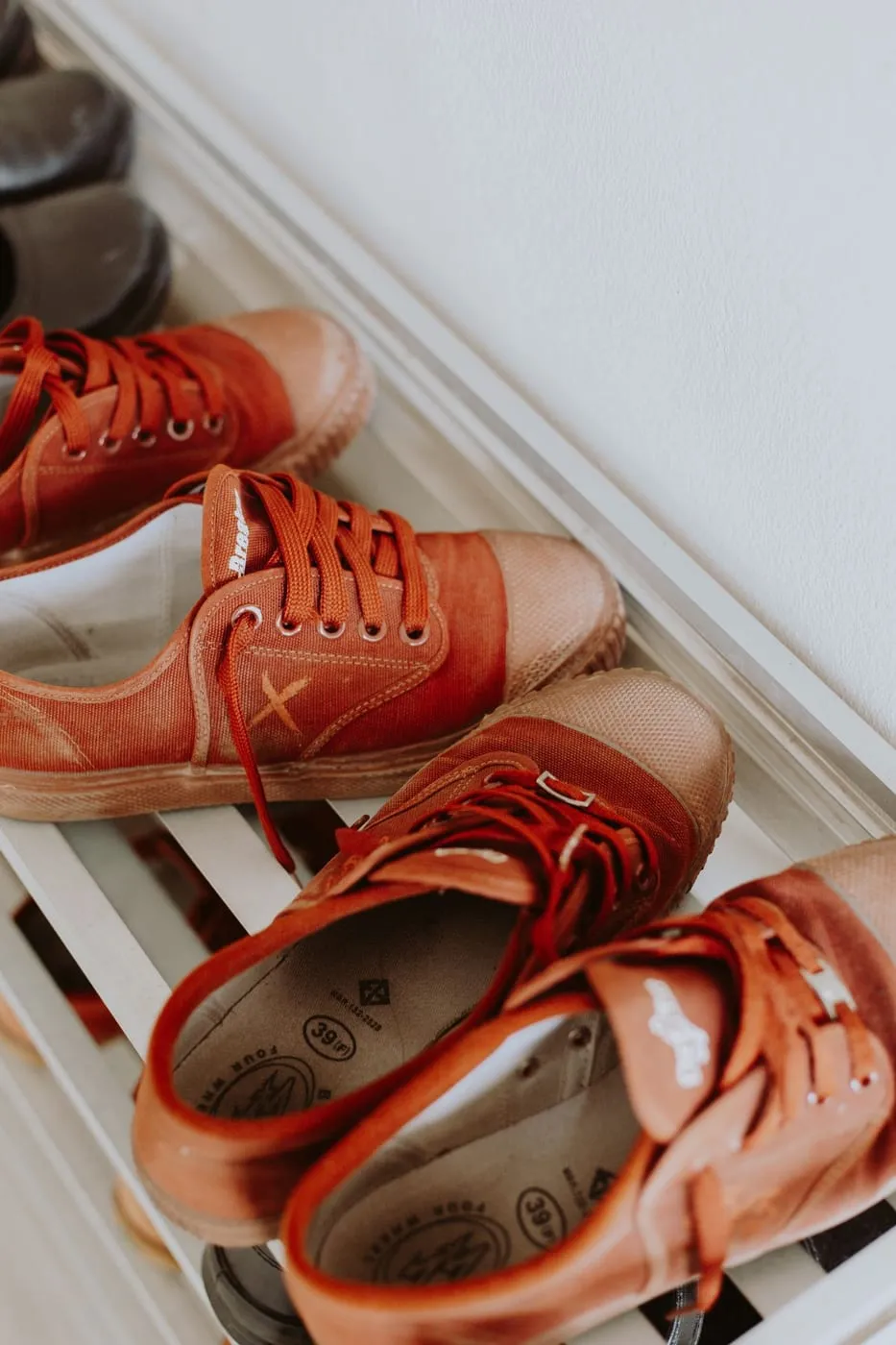
Shoes are disproportionately difficult to store in a small Canadian apartment. They are bulky, irregularly shaped, and accumulate faster than almost any other category of belonging. A typical Canadian renter owns 15–25 pairs — more in cities where weather demands multiple footwear types (snow boots, rain boots, summer sandals, dress shoes, everyday sneakers). That collection needs a system, or it ends up as a pile near the front door that makes every entryway feel chaotic.
This guide covers every practical shoe storage method for small apartments in Canada, from entryway solutions to bedroom closet organisation to under-bed storage for seasonal pairs.
Start With an Audit
Before buying any storage product, count your shoes and categorise them:
Key takeaway: Effective shoe storage starts with an audit by frequency: 3–6 daily-use pairs stay near the door, 5–10 regular-use pairs go in the bedroom closet, 4–8 seasonal pairs move to under-bed storage, and 2–5 rarely worn pairs get packed away completely. Most people own 15–30 pairs total.
- Daily use (worn at least once a week): 3–6 pairs for most people — these stay near the door
- Regular use (worn 1–3 times a month): 5–10 pairs — these go in the bedroom closet
- Seasonal (winter boots in July, sandals in January): 4–8 pairs — these go in under-bed storage or high shelves
- Rarely worn (special occasion, backup): 2–5 pairs — pack these away completely
Most small apartment shoe storage problems are solved partly by this audit. If 8 pairs of shoes are near the door and only 3 are worn regularly, the other 5 belong somewhere else. Shoe storage should hold what you actually reach for — not the entire collection in one spot.
Zone 1: Entryway Shoe Storage
The entryway is where shoes come off and pile up. The goal is a system that holds the 3–6 daily-use pairs without requiring effort to maintain.
Slim shoe rack (simplest, no installation)
A freestanding shoe rack beside the front door is the standard solution. The key spec for a small apartment is depth — a rack 20–25 cm deep fits in almost any entryway without blocking the path.
Canadian options:
- IKEA TJUSIG (~$25): Bench-style shoe rack, holds 4–6 pairs on two levels, 52 cm wide × 22 cm deep. Clean white or black finish. One of the most space-efficient options at this price.
- IKEA HEMNES shoe cabinet (~$150–$200): Enclosed cabinet with flip-down doors, holds 8 pairs, 89 cm wide × 30 cm deep. Looks like a sideboard rather than a shoe rack — better for apartments where the entryway is visible from the living room.
- Stackable shoe shelves (Amazon.ca, ~$20–$35 for 3 tiers): Metal or plastic, hold 2 pairs per tier, stackable to any height. Good value, no assembly required.
- SONGMICS slim shoe rack (Amazon.ca, ~$30–$50): 3–5 tiers, 25 cm deep, available in white and black. The most-reviewed shoe rack on Amazon.ca Canada (19,000+ ratings) — consistently recommended by Canadian buyers for build quality at the price.
Entryway bench with shoe storage
A storage bench at the front door solves three things: a place to sit while putting shoes on, storage for shoes underneath, and a surface for keys and bags on top. In apartments with a small but defined entryway, this is the best single-piece solution.
Canadian options:
- IKEA TJUSIG bench (~$50): 80 cm wide, open shelf below for 3–4 pairs, holds 100 kg seated weight. Basic but functional.
- Wayfair Canada storage benches (~$80–$180): Wide selection with upholstered seats and shoe shelves or cubbies below. Charlton & Jenrick and Ebern Designs brands are frequently stocked with fast Canadian shipping.
- Amazon.ca upholstered storage bench (~$60–$120): Budget-friendly options from VASAGLE and Songmics hold 3–4 pairs under the bench with open or enclosed storage.
Depth check: Most entryway benches are 30–35 cm deep. Confirm your entryway wall has this clearance before ordering — a bench that blocks the door swing is worse than no bench.
Over-door shoe organizer (for the back of the front door)
An over-door organizer on the back of the front door holds 12–24 pairs in clear pockets with no floor space used. Works best when the front door swings inward and there is enough clearance behind it.
What to check first: Open the front door fully. Is there 15–20 cm of clearance between the door and the nearest wall or obstacle when fully open? If yes, an over-door organizer works. If the door swings into a narrow corridor, the organizer may catch on the wall.
Cost: $20–$40 at Amazon.ca. Clear-pocket versions (so you can see which shoe is where) are worth the small premium.
Zone 2: Bedroom Closet Shoe Storage
The regular-use shoes — worn a few times a month — belong in the bedroom closet. The floor of the closet is the natural zone, but without organisation it becomes a pile that blocks access to everything behind it.
Two-tier shoe rack on the closet floor
A two-tier rack doubles the floor capacity of a standard apartment closet. A 60 cm wide rack holds 8–10 pairs on two levels. Position it at one end of the closet to leave the remaining floor space free.
Cost: $20–$40 at Amazon.ca, Canadian Tire, or Walmart Canada.
Angled vs. flat: Angled racks (shoes rest at a tilt with the toe pointing down) use less depth per pair — about 18 cm vs. 25 cm for flat storage. Better for narrow closets. The trade-off is that high-heeled shoes and boots do not work well on angled racks.
Over-door organizer on the closet door
The back of the closet door adds 12–24 pair capacity with zero floor use. Clear pockets (IKEA SKUBB or Amazon.ca equivalents, $10–$20) make identification easy. Hang with an over-door hook — no mounting required.
Best for: Flats, sandals, sneakers, and any shoe that fits in a standard pocket (roughly 15 × 10 × 5 cm). Not suited for tall boots or chunky-soled shoes that are too thick for the pockets.
Stackable clear shoe boxes
Clear stackable shoe boxes (Amazon.ca or Dollarama) let you see every pair without opening anything, stack cleanly in the closet, and protect shoes from dust. Each box holds one pair and takes up roughly 35 × 22 × 14 cm.
A stack of 12 boxes takes up 35 cm of floor depth and about 55 cm of height — fits in most closets beside the hanging section. The main advantage over a rack: shoes stay dust-free and the stack is stable even when the closet is accessed daily.
Cost: $2–$5 per box at Amazon.ca, Dollarama, or HomeSense. A set of 12 runs $15–$40 depending on brand.
Drop-front clear boxes (~$4–$8 each, Amazon.ca): The front drops down instead of lifting off, so you can grab a pair without removing the box from the stack. More convenient than standard lid-off boxes for shoes accessed regularly.
Zone 3: Under-Bed Shoe Storage
Seasonal shoes and rarely-used pairs live best under the bed, out of the closet entirely.
Flat under-bed shoe organizers
A flat fabric organizer with individual pockets for each pair slides under the bed and holds 12–16 pairs in a single layer. The organizer rolls or folds for travel. Depth is typically 10–12 cm — works under any platform bed with 15+ cm of clearance.
Cost: $15–$30 at Amazon.ca or HomeSense.
Best for: Sandals, flats, sneakers, and any low-profile shoe. Not suited for boots.
Under-bed storage boxes for boots
Flat-lid clear storage boxes (IKEA SAMLA or Amazon.ca equivalents) in the 55 L size lay flat and hold 2–4 pairs of boots depending on size. Slide them under a bed with 20+ cm of clearance. Label the box or use clear-sided versions to identify contents without pulling out.
Cost: IKEA SAMLA 55 L box with lid, ~$8. A pair of boxes for seasonal boots runs $16–$20.
Zone 4: Boot-Specific Storage
Tall boots need vertical storage — they fall over when laid flat and are difficult to stack. Three practical options for Canadian apartments:
Boot shapers
Cardboard or foam inserts that slide inside the boot shaft, holding it upright. Each boot stands independently on the closet floor in a row. Takes about 15 cm of depth per pair.
Cost: $10–$20 for a set of 4 at Amazon.ca. DIY version: roll a magazine and secure with a rubber band — works just as well.
Freestanding boot rack
A vertical rack with individual slots for boot pairs, typically holding 3–5 pairs in a 40 cm wide × 25 cm deep footprint. Stands on the closet floor or beside the wardrobe.
Cost: $25–$45 at Amazon.ca. SONGMICS and Greenco are common Canadian-stocked brands.
Over-door boot hangers
Hooks that mount over the top of a door, holding boots by their heel. Two pairs per hook, three to four hooks per door. Works for knee-high and ankle boots with a sturdy heel.
Cost: $15–$25 at Amazon.ca for a 3-hook set.
Choosing the Right System for Your Apartment
| Situation | Best solution |
|---|---|
| No entryway, shoes pile at the door | Slim shoe rack (20–25 cm deep) beside the door |
| Small defined entryway | Storage bench (seating + shoe shelf) |
| Closet with one rod and no shelving | Two-tier floor rack + over-door organizer |
| 25+ pairs to manage | Clear stackable boxes in closet + flat organizer under bed |
| Mostly boots | Boot shapers in closet + seasonal pairs in under-bed boxes |
| Renting, no drilling preferred | All options above require zero installation |
Price Reference (Canada, 2026)
| Product | Where | Price CAD |
|---|---|---|
| Slim 3-tier shoe rack | Amazon.ca, Canadian Tire | $20–$35 |
| IKEA TJUSIG bench | IKEA Canada | $25–$50 |
| Storage bench with shoe shelf | Wayfair Canada, Amazon.ca | $80–$180 |
| Over-door clear pocket organizer | Amazon.ca | $20–$40 |
| Two-tier closet floor rack | Amazon.ca, Walmart Canada | $20–$40 |
| Drop-front clear shoe boxes (12-pack) | Amazon.ca | $25–$50 |
| Flat under-bed shoe organizer | Amazon.ca, HomeSense | $15–$30 |
| Boot rack (freestanding) | Amazon.ca | $25–$45 |
| Boot shapers (4-pack) | Amazon.ca | $10–$20 |
For the full entryway storage picture beyond shoes — hooks, key storage, bag hanging — see entryway and hallway storage ideas. And for overhauling the bedroom closet that holds the rest of your shoes, closet organization for small apartments covers the full system.